Creating a Dopamine Menu That Works
If you work from home, you know how easy it is for your day to get hijacked.
You sit down to research your next project or answer client emails, and twenty minutes later, you’re scrolling social media, browsing your favorite online shop, wandering into the kitchen for another snack, or convincing yourself that folding a load of laundry suddenly became the most urgent task on your to-do list.
It isn’t because you’re lazy or lack self-discipline. Your brain is looking for a dopamine hit—a quick reward to break up the mental effort of focusing. When you’re working from home, those distractions are always within reach, making them incredibly hard to resist.
The problem isn’t that you need dopamine. The problem is that when your brain starts searching for it, the easiest options are usually the least helpful.
That’s where a dopamine menu comes in.
A dopamine menu is a pre-built list of activities organized by the type of boost you need. Instead of automatically reaching for your phone or getting pulled into another distraction, you can choose something that genuinely helps you recharge.
Think of it like a restaurant menu for your brain, except instead of ordering food, you’re choosing activities that leave you feeling refreshed, refocused, and ready to get back to work.
Working from home will always come with distractions, but having a plan makes it much easier to recognize when your brain needs a break and to choose one that actually helps, rather than stealing the next hour of your day.
I may earn commissions if you shop through the links on this page at no additional cost to you. See my full disclosure policy.
For more information about the chemistry, see The Molecule of More: How a Single Chemical in Your Brain Drives Love, Sex, and Creativity.
What Is a Dopamine Menu?
A dopamine menu (sometimes called a dopa menu) is a personalized list of activities designed to help you choose healthier sources of dopamine throughout your day.
The concept has exploded in popularity online, especially in productivity and ADHD communities. Though the name is relatively new, it is a rebranded concept reflecting what psychologists refer to as behavioral activation.
Behavioral activation is a strategy often used to encourage people to engage in meaningful activities, particularly when they’re struggling with low motivation. Instead of waiting until you feel motivated, you take action first and allow motivation to follow.
A dopamine menu works on a similar principle. Rather than relying on endless scrolling, online shopping, or other forms of instant gratification, you create a menu of activities that support your well-being and help you best manage energy throughout the day.
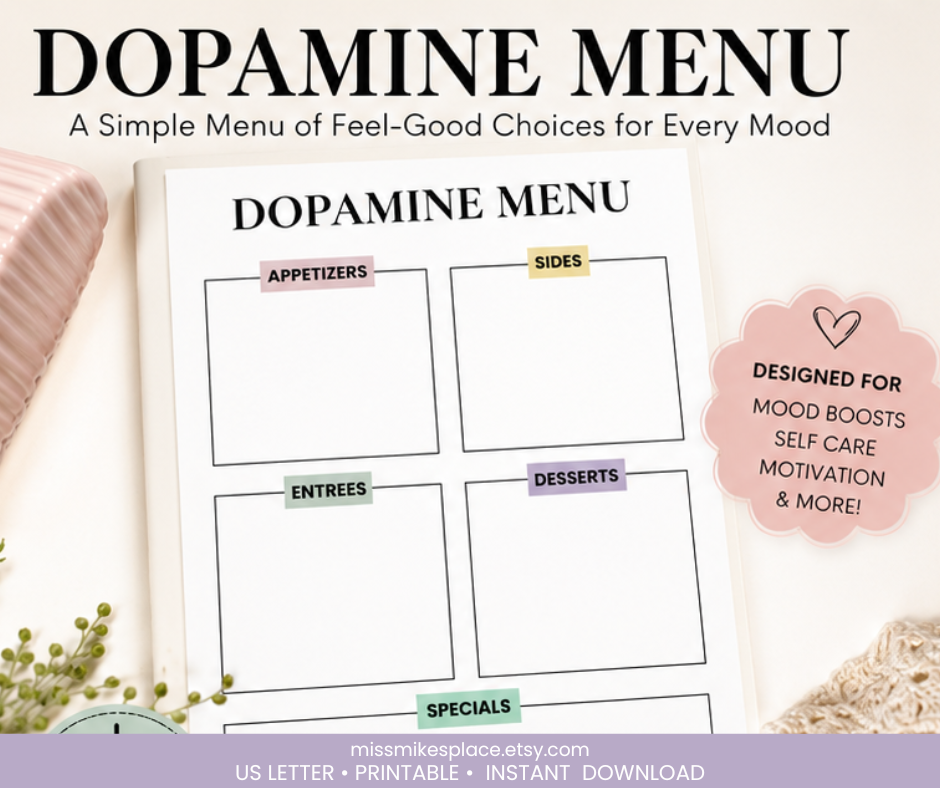
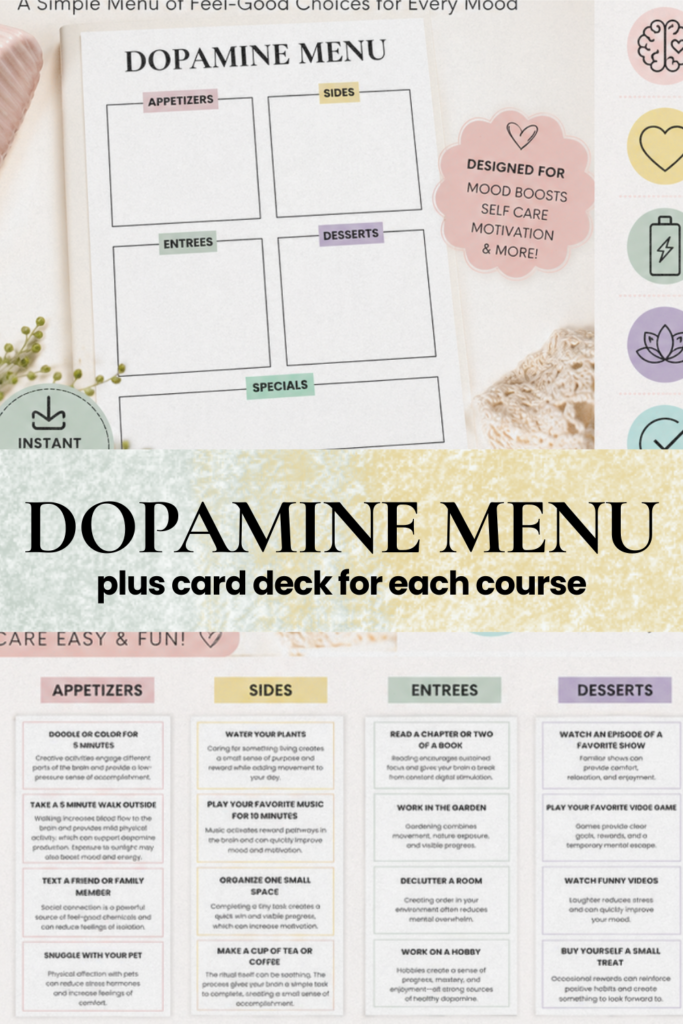
Dopamine Menu and Suggestion Cards
Break the cycle of mindless scrolling and replace it with simple, intentional activities that truly leave you feeling refreshed. This printable Dopamine Menu is a practical tool designed to help you choose healthier ways to improve your mood, increase productivity, and build lasting positive habits.
What a Dopamine Menu Is and Why Your Brain Needs One
Your brain doesn’t care whether dopamine comes from a productive task or a useless one. It simply wants the reward.
That’s why you reach for your phone when you’re bored, stressed, overwhelmed, or stuck. Your brain is looking for a quick payoff, and scrolling is often the easiest option available.
Dopamine is often called the brain’s feel-good neurotransmitter or feel-good hormone, but its role is much bigger than simply making you feel good. It plays several key roles throughout the nervous system, helping regulate attention, motivation, learning, movement, and our overall sense of reward.
Specialized nerve cells release dopamine, and part of this reward process involves an area of the brain called the nucleus accumbens, or the reward center, which helps drive the brain’s natural reward system.
The problem is that your brain often defaults to whatever provides the fastest reward.
Social media, social media likes, video games, YouTube rabbit holes, and even online shopping are designed to provide a quick and temporary burst of dopamine. Unfortunately, those rewards rarely leave you feeling satisfied for long.
A dopamine menu gives your brain a curated list of alternatives that deliver satisfaction without regret. You’re not fighting your brain. You’re redirecting it toward better options.
This works because decision fatigue is often the real problem.
When you’re carrying a heavy mental load, your brain naturally chooses the path of least resistance. That’s why reaching for your phone feels easier than taking a short walk, calling a friend, or working on a project.
A dopamine menu removes the thinking step. You already decided what activities are worth your time. When your brain starts hunting for stimulation, you simply choose from the menu.
The result is less wasted time, more intentional breaks, and healthier habits that support your overall well-being.
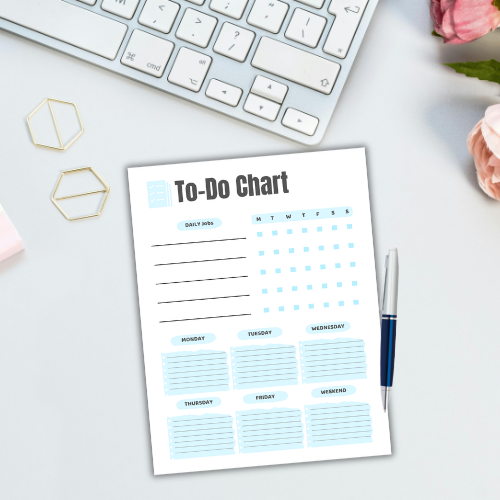
Download the chore chart below; use it to support your goals
Dopamine Menus and ADHD
Dopamine menus have become especially popular among people with attention deficit hyperactivity disorder (ADHD).
Many individuals with ADHD struggle with executive function, task initiation, time management, and regulating their energy level throughout the day. When motivation is already low, making decisions can feel even more difficult.
Researchers continue to study the relationship between ADHD and dopamine activity, dopamine production, and dopamine levels, but motivation is influenced by many factors beyond dopamine alone.
For many people, creating their own dopamine menu can be a simple and convenient way to reduce decision fatigue and make healthy choices easier.
The Four Core Categories Every Dopamine Menu Needs
Not every dopamine boost serves the same purpose. That’s why your menu should include different categories that match different situations and energy levels.
Entrées or Main Courses
These are your larger, more satisfying activities that typically take 30 to 90 minutes.
Examples include:
- Working on a creative project
- Going for a long walk
- Cooking a full meal
- Learning a new skill
- Deep cleaning a room
- Working in the garden
These activities require more effort but often provide the strongest sense of accomplishment.
Side Dishes
These are medium-length activities that take 10 to 30 minutes.
Examples include:
- Journaling
- Organizing your desk
- Reading a few chapters of a book in your comfy chair
- Calling or texting a friend
- Watering plants
- Stretching
These activities are perfect for transitions between tasks or when you need a productive reset.
Appetizers
These are quick activities that take five minutes or less and act as a happy brain break.
Examples include:
- Taking a short walk
- Listening to a favorite song
- Making a cup of tea
- Stepping outside
- Looking at favorite photos
- Petting your dog or cat
These are ideal when you’re experiencing low energy but still need a quick reset.
Desserts
These are intentional indulgences that you enjoy in moderation.
Examples include:
- Watching one YouTube video
- Scrolling social media for ten minutes
- Playing a mobile game
- Watching a favorite TV show
- Enjoying a favorite snack
The key is setting boundaries. If scrolling is on the menu, it gets ten minutes—not two hours.
Use your phone’s timer, a Pomodoro app, or this Pomodoro Timer Cube.
How to Build Your Personal Dopamine Menu in 10 Minutes
Start by opening your notes app or grabbing a notebook.
Spend a few minutes brainstorming activities that genuinely make you feel energized, relaxed, connected, creative, or accomplished.
The best menus include a mix of accessible activities, healthy activities, and a few intentional treats. Remember, this isn’t another overwhelming to-do list. It’s a collection of options you’ll actually want to use.
Try to come up with at least five activities in each category.
Ask yourself:
- What helps me recharge?
- What helps me feel connected?
- What activities make me lose track of time?
- What helps me feel accomplished?
- What activities do I enjoy in real life, away from a screen?
Once you have your list, save it somewhere visible.
Save it in your notes app, print it out, or make a physical list to keep on your desk, attach to the refrigerator, or add to a planner.
The easier it is to access, the more likely you’ll use it.
Why Dopamine Menus Work
One reason dopamine menus work so well is that they reduce activation energy.
When motivation is low, even deciding what to do can feel like a tough task.
Instead of spending mental energy trying to figure out what might help, you’ve already done the hard part. You simply choose a selected menu item and get started.
This is especially helpful because low motivation often creates a vicious cycle.
You feel unmotivated, so you avoid meaningful activities.
Because you avoid those activities, you feel even less motivated.
A dopamine menu interrupts that cycle by making healthy choices easier and more automatic.
Dopamine Menu Ideas by Energy Level
If you’re not sure where to start, these are some good examples based on how you’re feeling.
Low Energy
- Make a cup of tea
- Listen to calming music
- Sit outside for five minutes
- Watch a favorite TV show
- Stretch gently
Medium Energy
- Take a short walk
- Organize a drawer
- Read a chapter of a book
- Call a friend
- Work on a small project
High Energy
- Try new activities
- Start a creative project
- Go hiking
- Deep clean a room
- Learn a new skill
Common Mistakes That Kill Your Dopamine Menu Before It Starts
Many people build a menu and then never use it.
Here are the most common reasons why.
Mistake #1: Only Including Productive Activities
If every item feels like work, your brain will avoid the menu.
Your menu should include activities you genuinely enjoy, not just activities you think you should do.
Mistake #2: Making It Too Complicated
A giant list of fifty options creates the same decision fatigue you’re trying to avoid.
Five to ten activities per category are usually enough.
Mistake #3: Hiding the Menu
If your menu is buried somewhere you’ll never see it, it won’t help you.
Keep it visible and easy to access.
Mistake #4: Treating It Like a Rulebook
Your menu is a tool, not a test.
If something isn’t working, change it. Add new activities. Remove activities you never choose. Your menu should evolve with you.
A Quick Note About Dopamine Deficiency
A dopamine menu is a productivity and self-care tool. It is not medical treatment.
You’ll often see discussions online about dopamine deficiency, lower levels of dopamine, or lower-than-average levels of dopamine. While dopamine is important, motivation and mood are influenced by many biological, psychological, and environmental factors.
If you’re experiencing ongoing symptoms that interfere with your ability to function, it’s always a good idea to speak with qualified healthcare professionals who can provide personalized guidance.
The Bottom Line
Organizations like the Mayo Clinic and Cleveland Clinic often emphasize the value of movement, social connection, meaningful activities, and other natural ways to support overall well-being.
A dopamine menu may not be a cure-all, but it can serve as a powerful, effective, and genuinely useful tool for building healthier habits and keeping you focused on long-term goals.
Your brain will keep looking for dopamine whether you guide it or not.
The best thing you can do is make better options easy to find.
Build your menu today.
Use it tomorrow.
Adjust it as you go.
That’s the entire system—and sometimes the simplest systems are the ones that actually stick.
If you’re looking for another simple way to build momentum, pairing your dopamine menu with a few healthy micro habits can make a big difference. Tiny actions like drinking a glass of water before checking your phone, taking a five-minute walk between work sessions, or spending a minute tidying your workspace can help make your day feel more manageable. They won’t magically eliminate distractions, but over time, small, consistent habits can support better focus, productivity, and overall well-being. If you’d like more ideas, be sure to check out my post 10 Healthy Micro Habits That Will Improve Your Life for practical changes you can easily fit into your daily routine.